Bag of Beef Bones Bag of Beef Bones for Pho


Authentic Pho recipe from award-winning cookbook author and foremost expert in Vietnamese cuisine, Andrea Nguyen! With a broth that's calorie-free even so then full of flavor, information technology's infused with spices like cinnamon, star anise and cardamom. Utterly addictive!
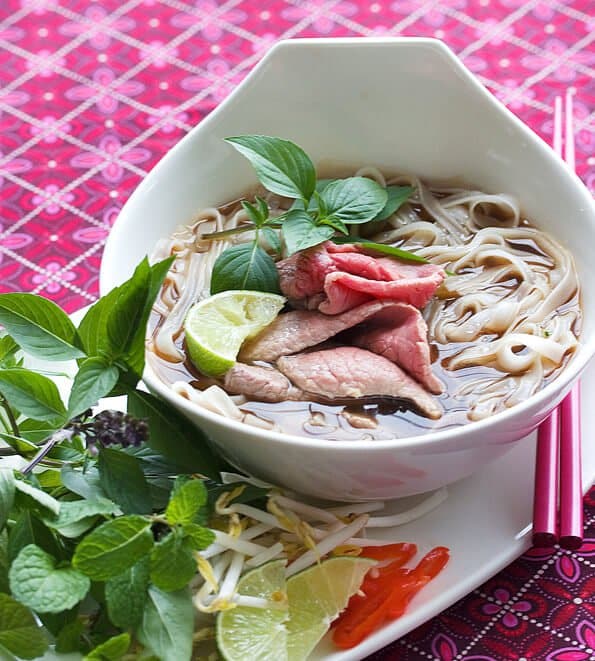
Why This Vietnamese Pho Recipe Is So Good
- Uses the best kind of beef bones
- A clear, clean goop (no scum!)
- A deeper, more savory flavor in this Pho recipe.
Ingredients
For the Pho broth
- Yellow onions
- Ginger
- Beef leg or knuckle bones
- Water
- Star anise, whole cloves, cinnamon, coriander seeds, cardamom, fennel seeds
- Beefiness chuck (or rump brisket/cross rib roast)
- Fish sauce
- Carbohydrate
For The Pho Bowls
- Apartment rice noodles
- Cooked beef (from the broth)
- Round sirloin, London broil, flank steak or tri tip steak
- Yellow onion
- Scallions
- Cilantro
Garnish for Pho Recipe
- Edible bean sprouts
- Mint
- Basil
- Chiles
- Lime wedges
How To Brand This Vietnamese Pho Recipe – Step Past Step
Make the Pho Goop
-
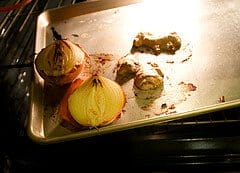
Set blistering rack 8 inches beneath heating chemical element. Plow oven to low broil. Identify the onion and ginger halves, cut side up, on a baking sheet. Castor the halves with a piffling bit of oil. Broil until the onion and ginger slightly charred, about 10 minutes, turning half-way. Remove from oestrus and cool.
-
Parboil the beefiness bones: Fill up a large stockpot (about 12 quart capacity) with water and bring to rapid boil. Carefully lower in the basic. Await until the water returns to a hard boil. Boil vigorously for three minutes to release the impurities. Dump bones and water into a clean sink, and rinse the basic with h2o to launder off whatever clinging residue. Speedily scrub pot make clean and fill with about 6 quarts of clean water. Return bones to pot. Add the charred onion, ginger, spices, beef, fish sauce, and sugar to pot.
-
Bring h2o to boil over high heat, and lower heat to gentle simmer. Simmer, uncovered, for i i/ii hours.
-
While simmering, use a ladle or fine-mesh strainer to spoon off any scum that rises on acme.
-
At this bespeak, the boneless meat should be slightly chewy, but not tough. Utilize tongs to transfer the meat to a bowl. Cover with plastic wrap and air-condition. Meanwhile, maintain the goop at a steady simmer for i i/ii hours longer.
-
Strain the goop through a fine-mesh sieve (or a coarse-mesh sieve lined with cheesecloth) positioned over a pot. Discard the remaining solids. Use ladle or fine meshed skimmer to skim as much fat as possible from the summit of the broth. Taste and adjust the flavor with salt, fish sauce and sugar. There should be about 4 quarts (16 cups) of broth.
Assemble the bowls
-
If using dried rice noodles, cover them with hot tap h2o and let them soak for 15 minutes, or until they are pliable and opaque. Drain in a colander. If using fresh rice noodles, untangle them, place in a colander, and rinse briefly nether cold running water.
-
Cut the cooked beefiness across the grain into thin slices. Freeze the raw beefiness for 15 minutes, so slice information technology across the grain into very thin slices. Set all beef aside. Ready the raw onion, scallions, cilantro leaves for adding to the bowls. Arrange the garnishes on a plate and put on the table.
-
To ensure adept timing, bring the goop to a simmer over medium estrus as you are assembling the bowls.
-
At the same time, fill a split up large pot with h2o and eddy. For each bowl, identify a portion of the noodles on a strainer (or mesh sieve) and dunk the noodles in the boiling water for 10 seconds. Immediately pull the strainer from the water, letting the h2o drain back into the pot. Empty the noodles into a bowl.
-
Top each bowl of noodles with cooked and raw beefiness, arranging the slices apartment. Add a scrap of raw onion, scallions, cilantro leaves to each bowl.
-
The pho broth needs to exist humid hot, to melt the raw beefiness slices. Enhance the heat of the broth to a boil. Practice a terminal gustatory modality and make any last minute adjustments with fish sauce and sugar. Ladle about 2 cups of broth into each bowl. Serve immediately with plate of garnishes.
Then, let'southward go correct to the Vietnamese Beef Pho Recipe!
The dish is pronounced "fuh" and non "foo" or "foe" or "puh"
Spices for Pho
Information technology'due south best if you can get each spice separately, but I do find that the spice packets are pretty convenient. They cost less than $2 and even come with a mesh bag to put all the spices in. Spices include cinnamon sticks, cloves, coriander pods, star anise and cardamom.
Pho seasoning made into a paste tin also come up in a jar or can, so that you can brand "instant pho." I've never liked the pho paste, information technology tastes flat, ordinarily full of MSG and too salty. Information technology's like using a bullion cube.

Best Bones for This Vietnamese Pho Recipe
Knuckle basic are the all-time to make the stock for pho recipe. The knobby knuckle bones, most the size of your fist, is total of gelatin – which gives body and richness to your broth. The knuckle basic make the biggest divergence in your broth! You lot can detect knuckle bones at Asian markets, only at regular supermarkets – you lot might have to ask your butcher.
Leg bones is also essential for the pho goop. Take a look at the photo below. The bone that's at 12-o'clock position is a leg bone that contains marrow. The marrow is skilful, but it'south extremely fatty. If I have a lot of marrow bones, I'll scoop out the marrow with a pocket-sized spoon or knife and discard afterward the par-boiling (see below). Having too much marrow volition give you a greasy film on your pho broth.
At Asian markets, bones for Vietnamese Pho are oftentimes sold in bags, already cut into 3″ sections, ready for broth making. Look in the freezer section if they don't accept the bones fresh. Nowhere near an Asian market? At a standard grocery shop, ask your butcher for knuckle and leg bones with marrow. The leg bones is best cut into about 3-inch sections.
Can't find leg or knuckle bones?
Simply let'due south say that yous can't find leg/knuckle bones. That'southward okay! Hither's what I apply:
- 3 pounds of whatever beef bones my marketplace has
- 1 pound oxtail bones
- i pound boneless beef chuck, rump, brisket or rib roast
Together, this combination will provide a rich, flavorful broth for Pho.
You must par-eddy bones start
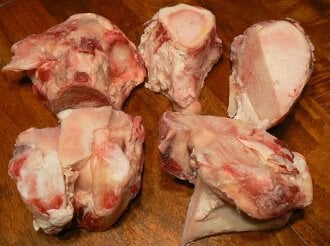
Bones are parboiled first in rapidly boiling h2o – this gets rid of the yucky impurities like blood particles and extra fat.
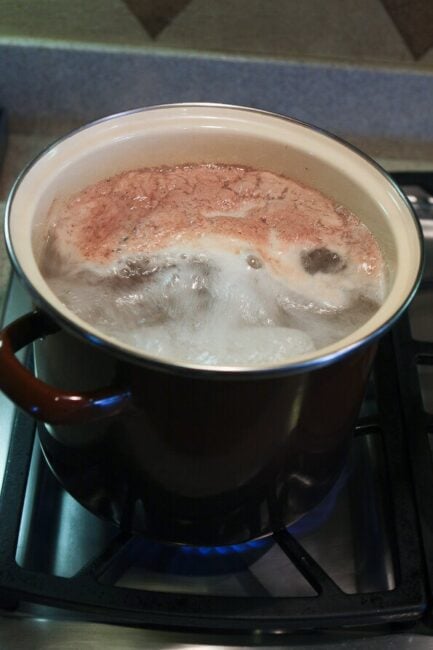
You lot'll meet pink or gray cream float upwards to the surface as you lot boil. Let it come up to a rapid, hard boil. And then after iii minutes, dump out all of the water, rinse out your pot, rinse the bones, and refill with clean, absurd water. I know it's an actress stride, but this will give you the pure, clean-tasting goop.
Os scum: this is what happens when you eddy bones. That nasty stuff will end up in your hard-worked pho broth if you don't dump it out!
If you have a lot of marrow bones, use a spoon or knife to scoop out and discard some of the marrow. Do this after the parboil, while the bones are still hot. The marrow can merely be scooped out when the basic are hot.
If yous take a lot of marrow bones, and don't scoop out the marrow, it's ok. The broth volition exist fatty, but you tin can also de-fat the broth by either of these methods:
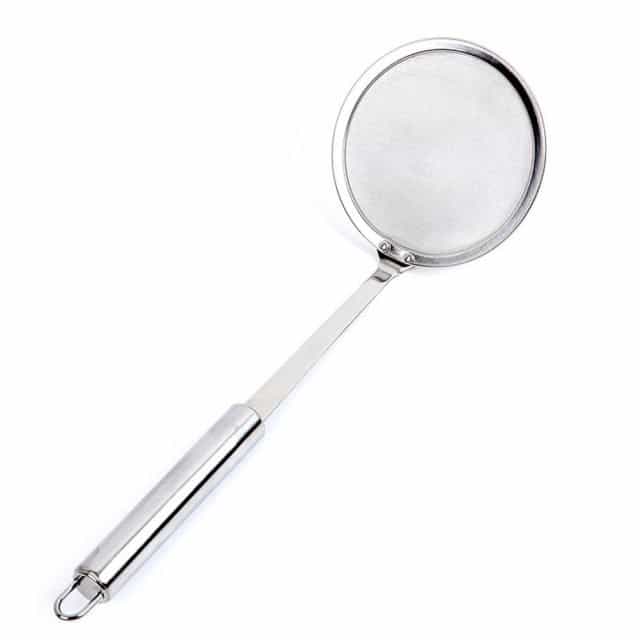
- Apply a scum strainer – an ultra fine mesh strainer that's specifically designed for….uh….straining scum and grease. Like this one on Amazon. Meet beneath for more information on de-scumming and de-greasing pho broth.
- Refrigerate the goop for a few hours. The fat volition solidify. Yous can merely use a large spoon to crack and elevator out the fat (marrow).
- But some marrow is benign….don't go rid of it all!
Charring Onions and Ginger
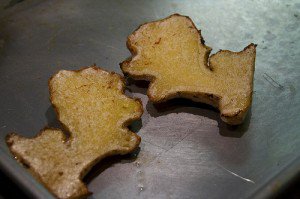
Charring or roasting the onions and ginger gives yous a wonderfully mellow and naturally sweet flavor. I used to char over an open up flame on my stovetop with a pair of tongs, but that got pretty tiring. Plus, metal tongs + long time over flame = very hothothot easily. So at present, I just raise my oven rack to the highest position and plough my broiler on. Encounter how gilded the ginger gets?
How to easily get rid of the cream & grease
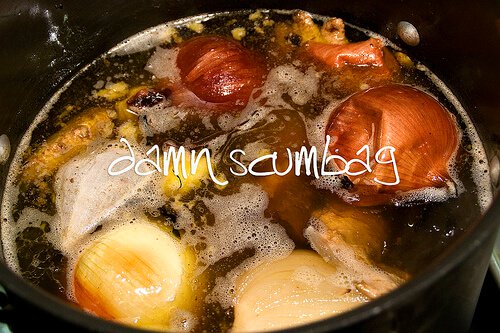
So here is my broth boilin' away with the mesh handbag of spices, charred ginger, charred onions and beef bones. You can run into floating bits of fat and the cream.
Fatty & marrow bits = good eats. Try to continue that in the broth!
But gotta get rid of the foam or scum! I employ a very, very fine mesh strainer ($ten) designed just for scum. Straining the scum and foam keeps your broth pure and clean. The lower the simmer, the less scum you accept.
A annotation on broth simmering time – I simmer the broth for 3 hours. According to both Andrea Nguyen and Corinne Trang (author of Authentic Vietnamese Cooking and erstwhile editor and director of Saveur's test kitchen) – all of the flavors in the bone have been extracted after 3 hours.
Thinly Sliced Meat for This Vietnamese Pho Recipe
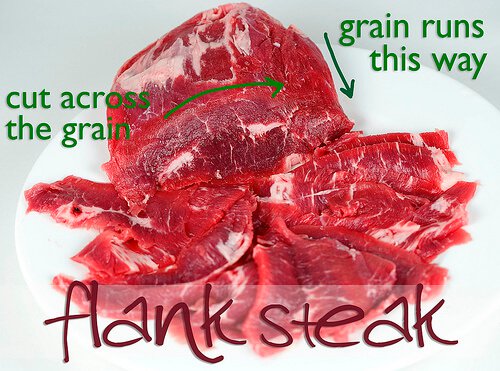
You can use a thinly sliced flank steak, london bake, sirloin, eye of round or tri-tip. Instead of beefiness slices, you could use beef balls (Bo Vien) found in the refrigerator or freezer section of your Asian market place.
The secret to slicing meat for Pho, is to cut Across the grain. Y'all want your beef slices as thin as possible, and I e'er throw the whole chunk of meat in the freezer for fifteen minutes to brand it easier to piece thinly.
Pho Noodles
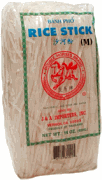
Vietnamese Beef Noodle Soup typically uses rice noodles. You tin can buy them dried or fresh. I love the slippery softness of fresh noodles (look in the fridge or freezer section.) Most restaurants volition apply dried, flat rice noodles. Wait for ones that are medium thickness and flat similar these.
Depression Carb Pho Recipe
To make Vietnamese Pho low-carb, substitute the rice noodles for Shirataki noodles, which are made from yam. Besides, Korean sweet irish potato noodles brand a fine low carb choice, too! Here'south a recipe for Paleo-Friendly, depression carb Vietnamese Pho (beef), and a recipe for Korean Japchae Noodles, which uses the sweet potato noodles.
Which Condiments Are All-time For Pho?
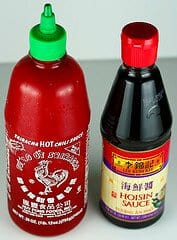
Pho-tastic condiments! On the tables of every Pho restaurant, you'll see these 2 condiments, Sriracha hot chili sauc) and Hoisin Sauce. You can eject and slather as much of these 2 condiments as you want…but I'1000 a purist.If I'one thousand going to spend a couple of hours carefully crafting a rich, flavor-packed, make clean soup – I better sense of taste every drib.
Though, sometimes, I'll squirt a scrap of each sauce in a piddling dish and dip my meat in the sauce equally I accept a bite.
Pho Vegetables and Herbs
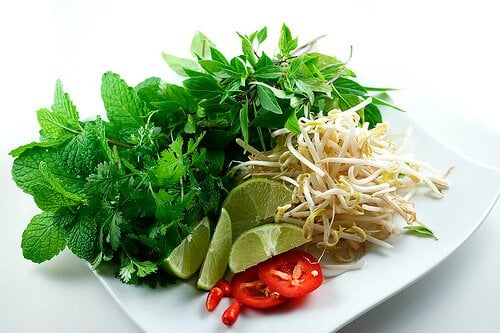
Fresh mint, cilantro, basil, bean sprouts, limees, sliced chili peppers are just some of my favorite accompaniments. Set a plate at the table and your guests tin can selection and cull what they like. Here'south a great Pho-tograph of fresh vegetables and herbs.
Elevation Tips For This Vietnamese Pho Recipe
- Parboil bones showtime in rapidly boiling water – this gets rid of the yucky impurities like blood particles and actress fatty.
- To make Vietnamese Pho low-carb, substitute the rice noodles for Shirataki noodles.
- The secret to slicing meat for Pho, is to cut Beyond the grain.
- Straining the scum and foam keeps your broth pure and clean. The lower the simmer, the less scum you lot take.
More Pho Recipes
- Crock Pot or Slow Cooker Pho!
- Vietnamese Chicken Noodle Soup (Pho Ga)
- Paleo-Friendly Pho – made in pressure cooker
Accept you tried this Vietnamese Pho recipe? Experience free to leave a star rating and I'd dear to hear from you in the comments below!
Vietnamese Pho Recipe (Beef Pho)
Recipe adapted with permission from Into the Vietnamese Kitchen Cookbook by Andrea Nguyen. Notation: You can detect "Pho Spice Pack" that includes all the spices at Asian markets. In Andrea's cookbook, she uses star anise, cloves and cinnamon stick. Some prefer the addition of fennel, coriander and cardamom, and I've noted those ingredients as "optional" in the recipe.
For the Pho broth
- ii yellowish onions unpeeled, sliced in one-half
- iv inch piece fresh ginger unpeeled, sliced in half
- v pounds beef leg or knuckle basic
- half dozen quarts water
- 5 star anise
- half-dozen whole cloves
- 1 cinnamon stick
- 1 tablespoon coriander seeds optional
- one pod cardamom optional
- one tablespoon fennel seeds optional
- 1 pound boneless beef chuck, rump brisket or cantankerous-rib roast, well trimmed, and cut into big chunks
- 1/iv loving cup fish sauce
- i tablespoon saccharide or ane-inch chunk of yellow rock saccharide
For the Pho Bowls
- 2 pounds small flat rice noodles dried or fresh
- Cooked beef from the broth
- 1/2 pound middle of round sirloin, London bake, flank steak or tri-tip steak, thinly sliced across the grain
- 1 yellowish onion sliced newspaper-thin, soaked in cold water to cover for 30 minutes and drained
- 2 scallions green parts only, thinly sliced
- 1/3 cup chopped fresh cilantro leafy tops but
Garnish for Pho Recipe
- three cups fresh bean sprouts near ane/2 pound
- Mint
- Thai basil
- 2 Thai or serrano chiles thinly sliced
- ii limes cutting into wedges
Brand the Pho Broth
-
Set baking rack 8 inches below heating element. Turn oven to low broil. Identify the onion and ginger halves, cut side up, on a baking sheet. Castor the halves with a piffling bit of oil. Broil until the onion and ginger slightly charred, about 10 minutes, turning half-way. Remove from heat and cool.
-
Parboil the beef basic: Fill a large stockpot (about 12 quart chapters) with water and bring to rapid boil. Carefully lower in the bones. Wait until the water returns to a hard boil. Boil vigorously for iii minutes to release the impurities. Dump bones and water into a clean sink, and rinse the bones with water to wash off any clinging residue. Quickly scrub pot make clean and fill with about 6 quarts of clean water. Return basic to pot. Add together the charred onion, ginger, spices, beef, fish sauce, and sugar to pot.
-
Bring h2o to boil over loftier estrus, and lower heat to gentle simmer. Simmer, uncovered, for ane 1/2 hours.
-
While simmering, use a ladle or fine-mesh strainer to spoon off whatever scum that rises on top.
-
At this bespeak, the boneless meat should be slightly chewy, just non tough. Utilize tongs to transfer the meat to a bowl. Cover with plastic wrap and refrigerate. Meanwhile, maintain the broth at a steady simmer for ane 1/two hours longer.
-
Strain the goop through a fine-mesh sieve (or a coarse-mesh sieve lined with cheesecloth) positioned over a pot. Discard the remaining solids. Use ladle or fine meshed skimmer to skim as much fat as possible from the top of the broth. Taste and accommodate the flavor with salt, fish sauce and sugar. There should be about 4 quarts (16 cups) of broth.
Gather the bowls
-
If using dried rice noodles, cover them with hot tap water and let them soak for 15 minutes, or until they are pliable and opaque. Bleed in a colander. If using fresh rice noodles, untangle them, place in a colander, and rinse briefly under common cold running h2o.
-
Cut the cooked beef across the grain into sparse slices. Freeze the raw beef for 15 minutes, and then slice it across the grain into very thin slices. Ready all beef bated. Ready the raw onion, scallions, cilantro leaves for adding to the bowls. Adapt the garnishes on a plate and put on the table.
-
To ensure good timing, bring the goop to a simmer over medium rut as yous are assembling the bowls.
-
At the same fourth dimension, fill a separate large pot with h2o and boil. For each basin, place a portion of the noodles on a strainer (or mesh sieve) and dunk the noodles in the boiling water for 10 seconds. Immediately pull the strainer from the water, letting the h2o bleed dorsum into the pot. Empty the noodles into a basin.
-
Top each bowl of noodles with cooked and raw beefiness, arranging the slices apartment. Add together a fleck of raw onion, scallions, cilantro leaves to each basin.
-
The pho goop needs to exist boiling hot, to melt the raw beef slices. Heighten the heat of the goop to a boil. Exercise a final taste and brand whatsoever last infinitesimal adjustments with fish sauce and sugar. Ladle about two cups of goop into each basin. Serve immediately with plate of garnishes.
Sodium: 1131 mg Calcium: 35 mg Vitamin C: 12.v mg Vitamin A: 105 IU Saccharide: 4 1000 Fiber: ii chiliad Potassium: 722 mg Cholesterol: 17 mg Calories: 292 kcal Fat: 1 thou Protein: 13 thousand Carbohydrates: 54 g Iron: 1.4 mg
Let u.s.a. know how it was!
What the Pho?!
Every bit an Asian cooking good, it has taken years of kitchen experiments, eating out and scouring for good recipes for the perfect home-cooked pho recipe. The best recipe that I've constitute for Pho is from:
Andrea Nguyen's Into the Vietnamese Kitchen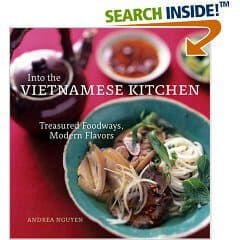 , which is i of the most comprehensive books on the cuisine of Vietnam. The book also won nominations for a James Beard Foundation award and two International Clan of Culinary Professionals (IACP). Definitely a must-have volume for Asian food lovers.
honeycutttherharded.blogspot.com
Source: https://steamykitchen.com/271-vietnamese-pho-recipe.html
0 Response to "Bag of Beef Bones Bag of Beef Bones for Pho"
Post a Comment